The Ascent of Mount Sneffels
A Journey to the Centre of the EarthThe Ascent of Mount Sneffels turns the expedition’s abstract wager into a dangerous physical undertaking: the party must climb a volcano more than five thousand feet high before the journey underground can truly begin. Its path is shaped by unstable rock, exhausting elevation, and a sudden storm of volcanic dust, while Hans’s steady judgment repeatedly becomes the difference between danger and survival. At the summit, the midnight sun offers a strange, pale pause before the descent into the crater.
Departure and Preparation
On June 23, Hans waited outside the presbytery with three companions and a carefully assembled load of provisions, tools, and instruments. Two iron-shod poles, two guns, and two large game bags were set aside for Professor Hardwigg and Henry. Hans had also brought a large skin of water in addition to their gourds, giving the travelers an estimated eight days’ supply. The preparations make the scale of the undertaking tangible: this is no longer a scientific speculation discussed at home, but a journey planned around the necessities of survival.
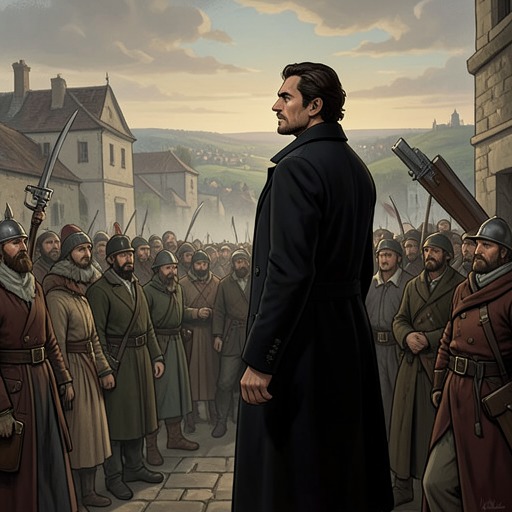
The party was ready by nine in the morning. The rector and his imposing companion watched from the doorway, but their farewell took the form of a bill charging the travelers for their stay, including the use of the dirty pastoral house. Professor Hardwigg paid without bargaining. Having resolved to attempt a voyage into the Interior of the Earth, he would not delay over a few rix-dollars. With the account settled, Hans gave the signal, and the expedition left Stapi.
The Mountain and Its Difficult Approach
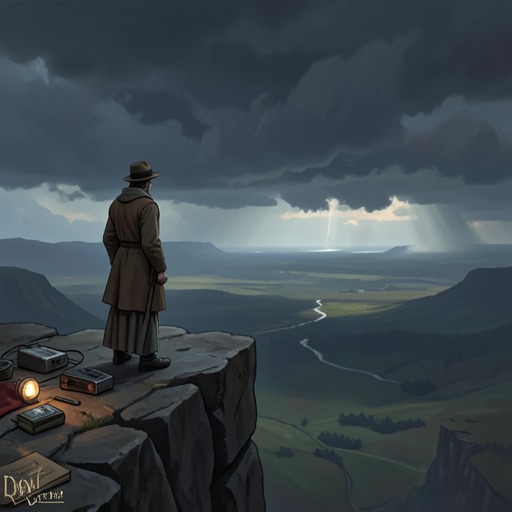
Sneffels, more than five thousand feet high, forms the end of a long range of volcanic mountains distinct in character from the rest of the island’s system. Its two pointed summits are difficult to distinguish from the party’s starting point: against the grey sky, the mountain appears as an immense white dome. The scale and obscured outline give the first stage of the expedition an imposing uncertainty. Henry, who had doubted the reality of the enterprise, begins to believe in it once the party is actually on the move.
As the climbers advance, the ground becomes broken and dangerous. Rocks give way underfoot, making constant care necessary to avoid falls. Hans proceeds calmly, sometimes disappearing behind great blocks before giving a shrill whistle to show where he is. He also stops to gather loose rocks and stack them in small heaps, marking a route the party may need to follow on its return. His quiet wayfinding supplies a practical counterpoint to the mountain’s scale and the narrator’s mounting fatigue.
After about an hour of severe exertion, they reach a broad field of ice surrounding the cone’s base, called the tablecloth by local people. There they find a natural flight of stone steps, formed by a volcanic torrent of rock known in Icelandic as stina. The steps exist because the mountain’s shape checked the torrent’s descent; without that obstruction, it might have swept into the sea and formed new islands. Though steep and difficult, the stone staircase offers the party a route upward where the abrupt slope would otherwise impede them.
The Dust Whirlwind
During the climb, a vast column of pulverized pumice, sand, and dust rises from the plain like a waterspout. Driven toward the climbers by the wind, the opaque cloud casts a deep shadow across the mountainside. The party faces the prospect of being crushed by the storm, which can lift and throw great stones as though an eruption were under way. The Icelandic name for the phenomenon is mistour.
Hans responds at once, turning toward the back of the crater and leading the party on a slightly ascending route. A quarter of an hour later, he stops so they can look back: the whirlwind has spread up the slope to the very place where they had intended to halt. They are outside the wind’s path, and therefore out of reach of the worst danger. The episode demonstrates the value of Hans’s knowledge in concrete terms; his decision changes the party’s likely fate from exposure to escape.
The danger passed, Hans still judges it unwise to spend the night on the bare side of the cone. The remaining fifteen hundred feet take at least five hours. Zigzags, detours, and dead ends turn that short distance into what Henry estimates as three leagues. Hunger, cold, and the rarefied air compound his exhaustion, until the climb feels nearly beyond his strength.
Summit and Threshold
At about eleven at night, when the region is dark, the party finally reaches the summit. Henry pauses before descending into the crater that will shelter them for the night. On the day of the sun’s lowest declination, he sees the sun rise at midnight, its ghastly pale rays falling across the island below as it lies in sleep. The spectacle briefly changes the character of the ordeal: the punishing climb opens onto an uncanny view that makes the remote journey itself seem real.
The summit is both an achievement and a threshold. The expedition has reached the great volcano that forms the first stage of its experiment, but the crater below is not the destination; it is the way toward the intended descent. The ascent therefore closes not with safety or completion, but with the party poised to go lower. Its narrative force lies in that reversal of scale: after the immense labor of climbing toward the sky, the next movement will be downward into the Earth.